Machine learning learns predictive relationships from historical data, mapping input variables (x) to outcomes (y). Supervised learning commonly forecasts future sales or identifies spam emails. section 4.0
Prediction and causation answer different questions. Machine learning can predict illness successfully from correlated information, such as hospital-visit frequency, even when important comorbidities are missing; causal inference cannot reliably identify causes without relevant variables. section 1.1.2 section 4.0
Use machine learning with these checks:
- Treat accurate prediction as dependent on the future behaving like the past. section 4.6
- Do not treat model accuracy or cross-validation alone as evidence of causation. section 4.0 section 4.6
- With many confounders, use machine learning inside the adjustment formula and apply cross-fitting to reduce over-fitting. section 4.6
Applying the adjustment formula
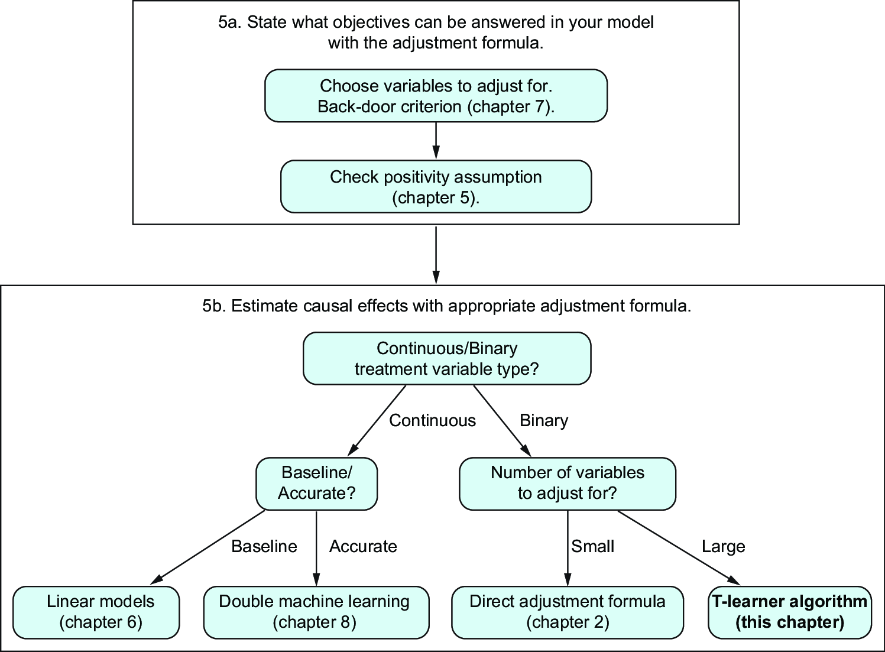
Trace how machine learning models can supply conditional probabilities within the adjustment formula. section 4.0