Machine learning replaces hand-written task rules with rules learned from data. Instead of telling a program exactly how to turn each input into an answer, you train a model on examples and let it find statistical structure that helps produce answers for new inputs. It is a subfield of artificial intelligence; deep learning is one approach within machine learning. section 1.3 section 20.1.1
Tagging vacation pictures
Suppose you want to tag pictures as “landscape” or “food.” Provide pictures that people have already tagged. The model uses those examples to learn associations between pictures and tags, rather than relying on a programmer to write a rule for every possible image. section 1.3
For a task with known expected outputs, the practical ingredients are:
- Input data, such as pictures or recordings of speech. section 1.4
- Expected outputs, such as image tags or human-written transcripts. section 1.4
- A measure of how far the model’s outputs are from those expected outputs. That feedback guides adjustments to the model; the adjustment is learning. section 1.4
The goal is not merely to memorize answers. A model learns transformations that make input data more useful for its task. Consider two ways to encode the same color image: RGB makes selecting red pixels simpler, while HSV makes reducing saturation simpler. A useful representation can turn a difficult operation into an easier one. Deep learning pursues this idea with stacks or graphs of layers whose weights are learned during training. section 1.4 section 20.1.1
Figure 1.2 Machine learning: a new programming paradigm
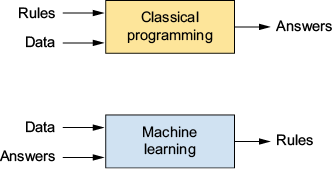
Use the diagram to compare the two directions: conventional programming supplies rules for turning data into answers; machine learning uses data and answers to learn rules. section 1.3









































