Machine learning trains a model on examples instead of asking a programmer to write every rule. Given input data, examples of the desired output, and a way to measure mistakes, the model adjusts how it works. The result is a learned way to turn new inputs into useful outputs. section 1.3 section 1.4
Tagging vacation photos
To tag photos as “landscape” or “food,” provide many pictures already tagged by people. The model learns statistical patterns associating pictures with tags, rather than following a hand-written checklist for each category. section 1.3
Figure 1.2 Machine learning: a new programming paradigm
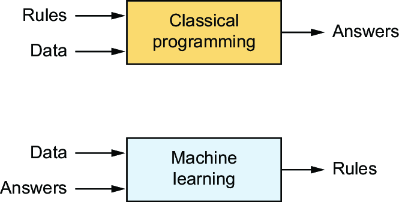
Compare the direction of ordinary programming—rules applied to data—with machine learning, where data and expected answers are used to learn rules. section 1.3
What a model learns is not just a collection of answers. It learns useful representations: ways of transforming data that make a task easier. An image, for example, can be represented as RGB or HSV values; selecting red pixels is simpler in RGB, while changing saturation is simpler in HSV. Deep learning is a branch of machine learning that learns successive representations through layers of a neural network. section 1.4 section 1.14
For a practical project, start with the problem, not with a model:
- Define the task, identify available inputs and desired predictions, and decide how success will be measured. section 6.0 section 6.1.1
- Collect and prepare data, develop a model, and choose an evaluation protocol. Watch for overfitting: doing well on training examples is not the same as generalizing. section 6.0 section 5.0
- Deploy and maintain the model when it is ready for production. section 6.0
Machine learning sits within artificial intelligence, but not every AI approach learns from data: early chess programs used hand-coded rules. Nor is every machine learning problem a deep learning problem. A recommendation system, for example, may be better handled with matrix factorization. section 1.2 section 6.1.1









































