Machine learning (ML) uses statistical and mathematical algorithms to find patterns in historical data and support data-driven decisions. It can uncover relationships, similarities, trends, and anomalies across more variables than a person can readily assess at once. The algorithm still has to be coded, and useful results depend on understanding the business problem. section 1.4
Start with a clear, measurable question, then prepare the data needed to answer it. Data engineering supplies and cleans the data; analysis and visualization help inspect it before modeling. Check quality as well as availability: incomplete, inaccurate, inconsistent, or outdated data can undermine the result. Choose a modeling approach according to the problem and the historical data available. section 1.3 section 1.7 section 1.5
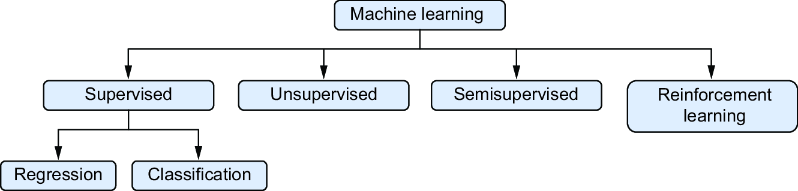
Four broad learning approaches address different kinds of problems:
- Supervised learning uses existing data to predict outcomes, including quantitative values through regression and categories through classification. section 1.7
- Unsupervised learning finds patterns without predefined target variables; segmentation and anomaly detection are common uses. section 1.7
- Semisupervised learning works with partially labeled datasets. section 1.7
- Reinforcement learning learns through trial and error, rewarding desired outcomes in dynamic decision-making tasks. section 1.7
Recommendations from shopping history
An online shop can recommend accessories by comparing a customer's preferences and past behavior with historical trends and with customers who behave similarly. The recommendation is an actionable result of patterns found in the data. section 1.4
Figure 1.10 ML algorithms can be classified as supervised learning algorithms, unsupervised learning algorithms, semisupervised learning algorithms, and reinforcement learning algorithms.
Use the four-part classification to locate an approach before selecting a particular algorithm. section 1.5









































