Machine learning learns relationships between historical demand, demand drivers, and desired future outputs from training data, then applies those learned relationships to new data to forecast demand. Rather than imposing a predefined equation for trend or seasonality, the algorithm detects patterns from the data. The resulting model is shaped by the chosen algorithm and its settings, but its learned relationships are not explicitly controlled. section 15.1 section 15.5
For demand forecasting, machine learning is most useful when a dataset is sufficiently rich to capture complex relationships among demand drivers. It can provide a high-accuracy forecast baseline, reducing manual forecast generation and focusing planners on review and exceptions. Limited data, few SKUs, and no demand drivers favor trying usual time-series models first. section 15.1 section 1.2.4 section 17.0
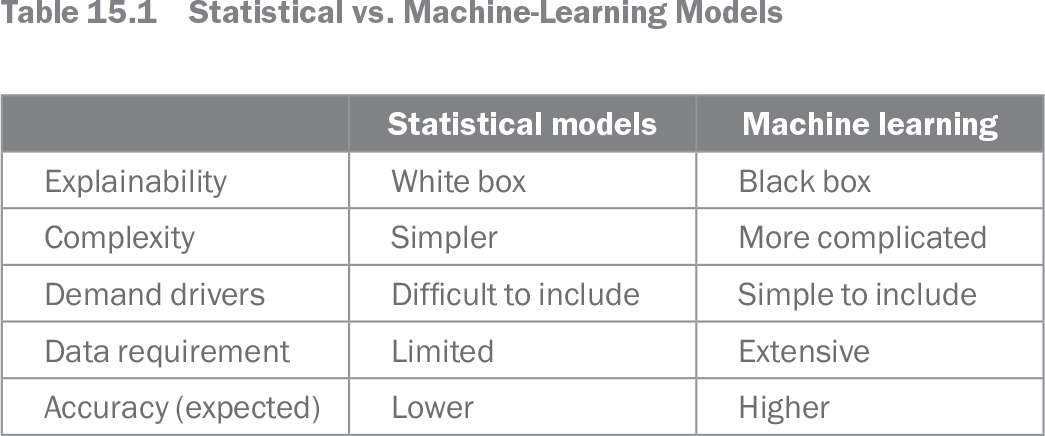
Table 15.1 Statistical vs. Machine-Learning Models (view table figure)
| Statistical models |
Machine learning |
|
|---|---|---|
| Explainability |
White box |
Black box |
| Complexity |
Simpler |
More complicated |
| Demand drivers |
Difficult to include |
Simple to include |
| Data requirement |
Limited |
Extensive |
| Accuracy (expected) |
Lower |
Higher |
Compare machine-learning and statistical models across explainability, complexity, demand-driver handling, data requirements, and expected accuracy. Machine learning makes drivers easier to include and may improve accuracy, but requires more data and creates a more complicated black-box model. section 15.1
Machine learning should not be treated as an automatic upgrade. Statistical models make components such as level, trend, seasonality, and driver effects visible; machine-learning models generally do not. Feature importance can indicate which inputs a tree-based model attends to, but not how a promotion changes demand. Scenario analysis can instead compare forecasts under different assumed driver values. section 15.1.2 section 15.1
Promotion scenario
Train a model with historical demand and drivers such as promotions. To inspect a proposed promotion, generate forecasts for alternative scenarios rather than assuming a fixed uplift. If promotion has high feature importance, treat that as evidence that the model uses it—not as a direct estimate of its effect. section 15.1.2 section 15.1
Launch an ML forecasting initiative by making business and evaluation choices explicit:
- Define the forecasting objective, including the required granularity, horizon, appropriate demand data, and metric before choosing fashionable models. section 15.4
- Separate test periods from feature selection and parameter optimization; assess accuracy only on historical data not used to tune the model. section 15.4
- Compare results at the same periods and granularity against a simple benchmark, the current forecasting engine, and the consensus forecast. section 15.4
- Set realistic expectations: improvement versus a benchmark can range from 0 to 30%, and overpromising can create user resistance. section 15.4
A practical aim is a customized forecasting model matched to the objective, data, and metrics—not merely a technically impressive algorithm. Strong accuracy can improve the baseline and lower team workload, while scenarios offer a limited but useful way to discuss demand-driver implications with stakeholders. section 15.5 section 15.3