Machine learning uses patterns in data to extend knowledge bases, generalize from incomplete information, and support predictions or actions under uncertainty. In intelligent advisory systems, it turns graph knowledge into insights for domains such as drug repurposing and personalized medicine. section 2.5.2 section 9.0
Graph-based machine learning organizes practical work around:
- Representing diverse data as interconnected graphs rather than assuming independent data items. section 9.1
- Solving node classification, link prediction, graph classification, and community detection tasks. section 9.4
- Balancing automated embeddings, domain knowledge, and task-specific algorithm selection. section 9.4
Personalized medicine
A graph-based system can process patient-similarity networks and biological pathways, while language models synthesize literature and clinical guidelines into explainable treatment rationales. section 9.1
Figure 2.12 An inductive reasoner. Constructing the knowledge base requires more effort; it is not a simple transformation. This reasoning engine can abstract from the knowledge base and work under some level of uncertainty.
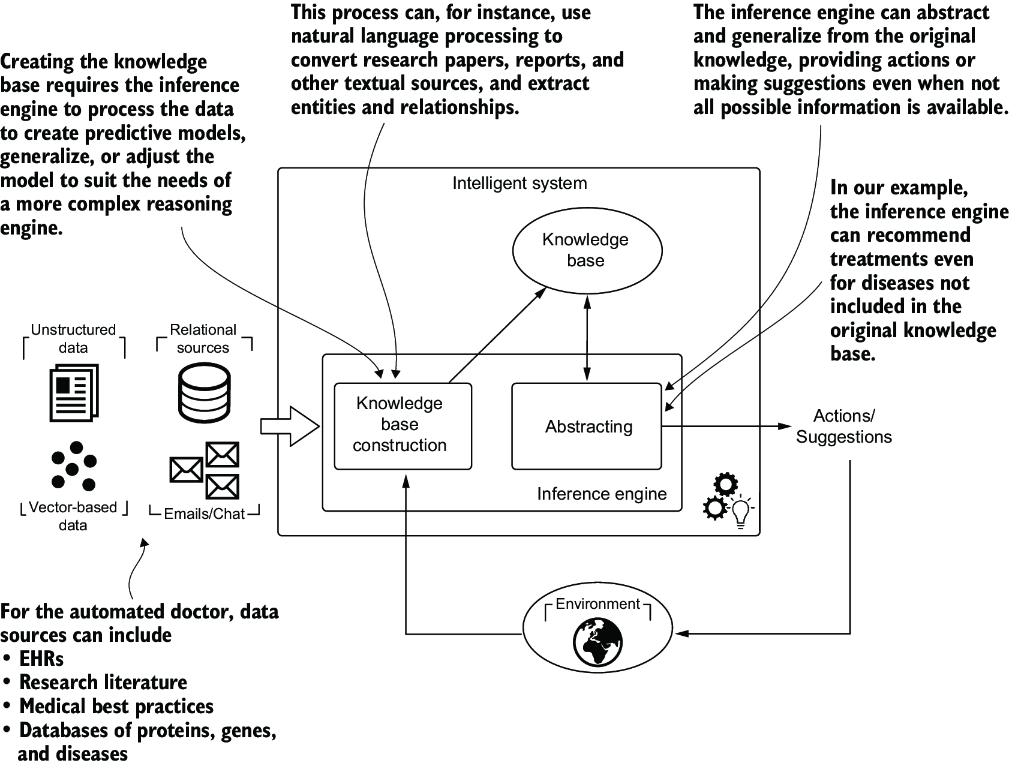
The inductive-reasoner diagram traces raw-data structuring, knowledge-base construction, and uncertain prediction or action. section 2.5.2









































