Machine learning trains models on data so they can perform tasks using learned patterns. In search, it can help replace some manually maintained rules and weights with behavior learned from content and user signals. It is one way to build AI-powered search, but not every AI system uses machine learning. section 1.0 section 1.1
A search engine first finds documents matching a query, then ranks them by relevance. Machine learning can contribute at several points: interpreting the query, learning relevance features and their weights, or using user signals to improve ranking. This does not remove the need to decide which signals matter or to check whether the results are useful. section 1.1 section 3.3 section 1.0
Product-search ranking
Consider a product query with several matching results. A manually tuned system might rank them using fixed field weights and business rules. A machine-learning approach can instead learn and weight relevance features for that search domain, drawing on content and, where collected, user signals. The practical question remains whether the resulting order serves the user better. section 1.0 section 1.1 section 3.3
Figure 1.2 Specific AI-powered search techniques, broken down by whether they are deep learning techniques, other machine learning techniques not requiring deep learning, or other artificial intelligence techniques not requiring machine learning
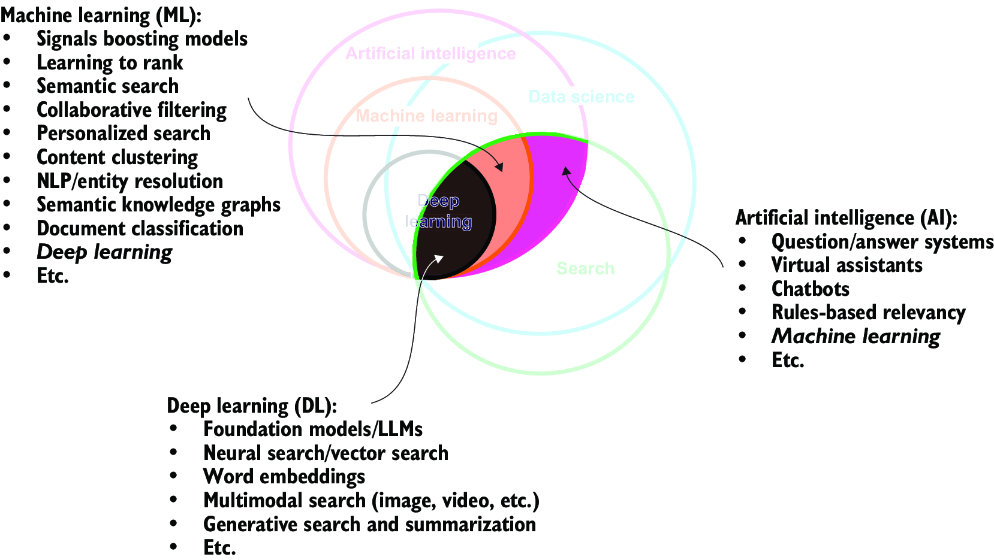
The diagram distinguishes deep-learning techniques from other machine-learning techniques and AI techniques that do not require machine learning. section 1.1
Machine learning is not a reliability guarantee. Ranking models can be biased, and generative systems can produce inaccurate answers unless grounded in a trusted information source. Treat automated relevance as something to evaluate and improve, not as a substitute for relevance engineering. section 1.0 section 3.3









































