Machine learning uses statistical algorithms that learn patterns from data and perform tasks without explicit instructions. In financial research, it turns security data into additional insights for investment decisions, but volatile markets make confident forecasting unreliable. section 1.3 section 8.1
Financial machine-learning workflows commonly distinguish:
- Supervised learning trains on labeled data: company features are paired with a later price direction, allowing predictions for unlabeled data. section 8.1
- Unsupervised learning is identified as another model category, alongside supervised learning. section 8.1
- Traditional machine learning is discriminative and narrow, targeting specific outcomes rather than the broader creative applications associated with generative AI. section 8.2 section 8.2.4
- Stock-price prediction remains difficult because markets can behave like random walks, reflect available information, and contain limited predictive patterns. section 8.0 section 8.1.3
One-year price classification
A supervised model can receive quantifiable company data as features and a label indicating whether the stock price becomes higher or lower one year later. A related demonstration produces high, low, and mean one-year NVIDIA forecasts from data collected through yfinance. section 8.1
Figure 1.1 A survey of the tools and techniques covered in this book, including pointers to the chapters that focus on the relevant domains
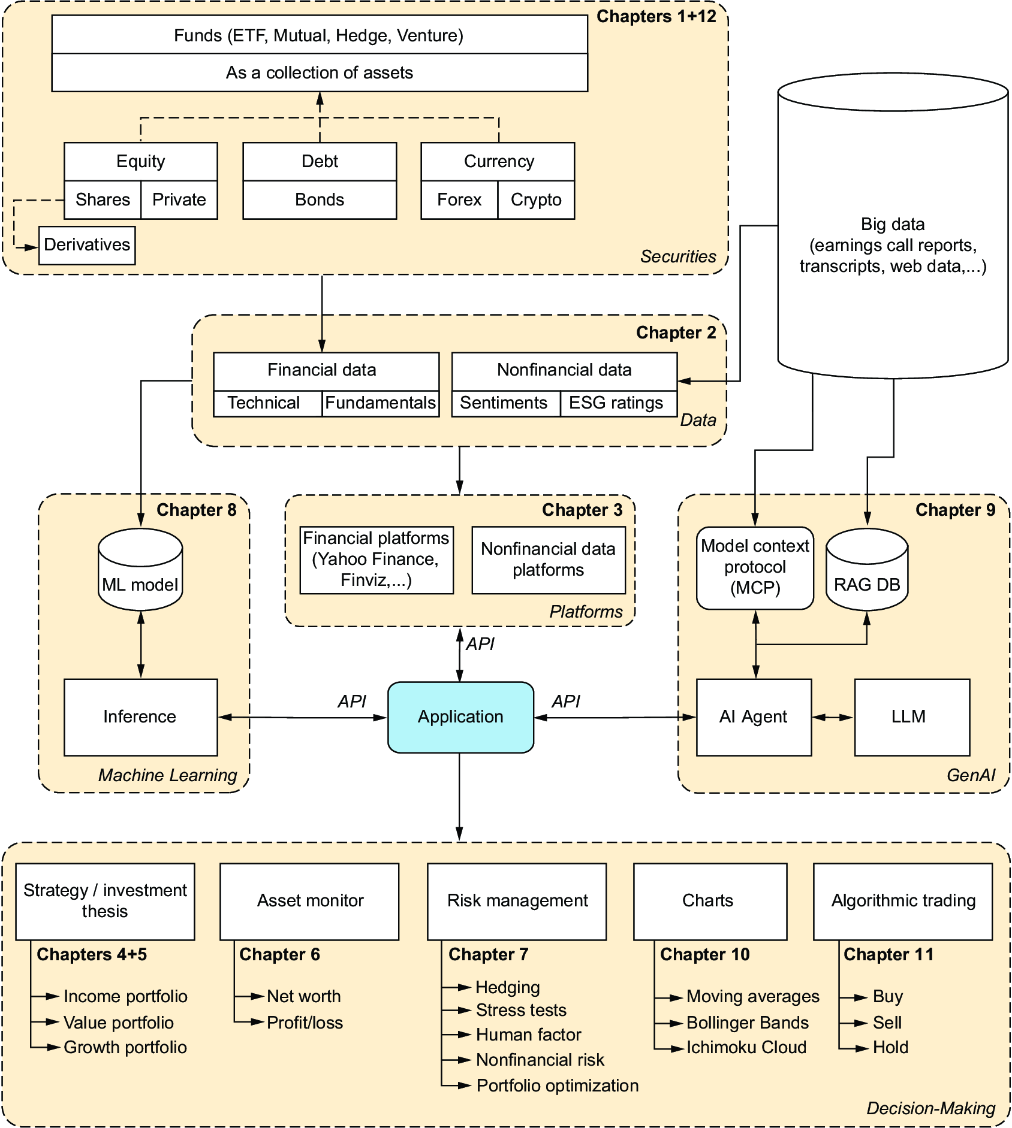
Use the process overview to locate machine learning among the financial data, analysis, and decision-making techniques. section 1.3









































