A large language model (LLM) is a deep neural-network text-prediction system trained on massive text corpora. It learns statistical relationships among tokens—units that can range from characters and words to sentences and paragraphs—and generates by selecting likely next tokens from the available context. At scale, this supports natural-language tasks such as summarizing logs, rewriting code, and describing an attack surface. section 1.2 section 2.2
Figure 1.3 An illustrative example of how an LLM generates the next token. As the LLM generates a sentence, it considers the context of the previous words that were generated. The LLM takes in the last token and assesses the probability of the next token. In the example above, since green has the highest logit value, it is the next word to be generated in the sentence.
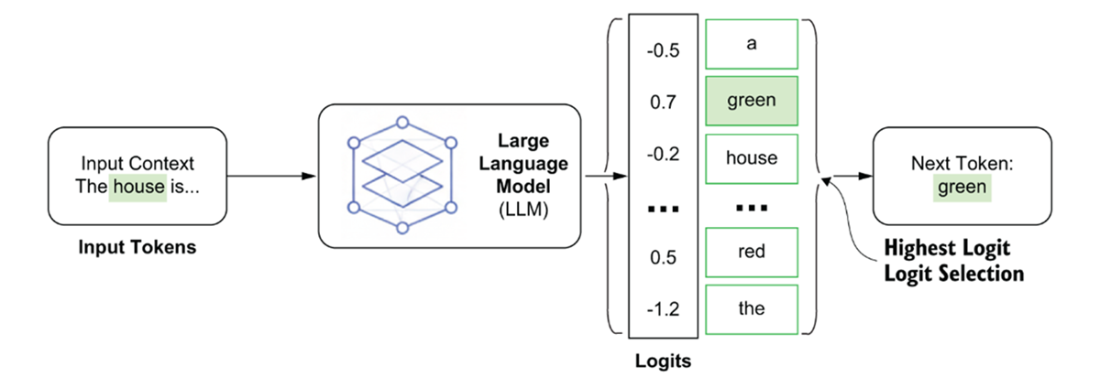
Next-token generation is context-dependent: the model scores possible continuations and emits the likely next token. section 1.2
In security work, an LLM can turn scanner or API output into structured interpretation: summarize findings, identify anomalies, and suggest next steps. This is useful when engagements produce more endpoints, parameters, headers, and responses than a person can inspect directly. Its role is interpretive reasoning over textual inputs, not independent execution or durable state management. section 1.2 section 2.1 section 2.2
Treat an LLM as a stochastic reasoning API with explicit operational limits:
- It can hallucinate: produce plausible, confident information that is incorrect or fabricated. section 1.2
- Its output is non-deterministic, so identical input can yield different responses; high-stakes security decisions require validation. section 1.2
- It has no memory between API calls, reacts to individual prompts, and cannot by itself persist state, adapt to environmental changes, or justify decisions. section 2.1 section 2.2
- Training data requires careful curation because models can memorize or overfit poorly cleaned data. section 1.2
An AI agent extends an LLM rather than replacing it. The LLM supplies language generation and reasoning; orchestration determines the next step. Tools enable external actions, memory preserves prior interactions, and a knowledge base supplies grounding context. With goals, planning, evaluation, and feedback loops, the surrounding system can perceive, reason, act, observe, and repeat—while retaining artifacts that make behavior reviewable and replayable. section 1.3.1 section 2.2
Controlled recon-data triage
A controlled agent can wrap an LLM with explicit messages, tools, and artifacts to interpret reconnaissance data as a decision-making loop. The resulting actions and observed responses can be recorded for inspection, replay, and defense. Human intervention and control gates remain necessary when outcomes affect a security engagement. section 2.0 section 2.2
Use LLM output as a candidate interpretation, then validate it through skilled human review and controlled pipeline stages for input, reasoning, action, evaluation, and reporting. This preserves the model’s ability to scale analysis without treating generated text as authoritative security evidence. section 1.7 section 1.2
























































































