A language model generates or evaluates natural-language token sequences. In a RAG system, it synthesizes answers from retrieved evidence rather than relying only on potentially outdated or incomplete training knowledge. section 1.2 section 1.3
Production use exposes three reliability constraints:
- Training knowledge is frozen in time and cannot directly access real-time data. section 1.3
- Confident, plausible-sounding generation can still be factually wrong, requiring relevant evidence and verification. section 1.3
- A public model may lack secure access to proprietary enterprise information. section 1.3
- RAG addresses these risks by retrieving and ranking evidence before the model generates a response. section 1.2
Warranty coverage
A pure language model might provide outdated warranty terms, confuse products, or miss documents absent from its training data. RAG retrieves relevant company policies and directs the model to synthesize a response grounded in that evidence. section 1.2
Figure 1.1 The RAG workflow: from user queries to grounded responses through retrieval and generation.
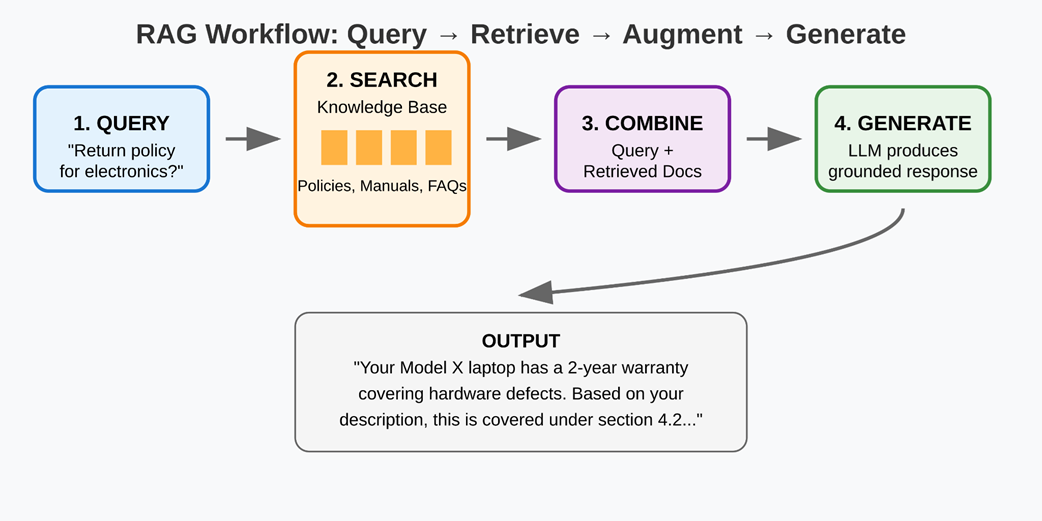
Trace how retrieval and ranking supply evidence that the language model turns into a grounded response. section 1.2
























































































