A language model learns patterns in language and uses them to assign probabilities to possible continuations. Large language models (LLMs) apply this approach at scale, producing text that can summarize information, draft reports, explain ideas, and respond to questions. Their fluency is useful, but it does not by itself establish that they understand or can verify what they say. section 2.1.2 section 6.1.2 section 1.1.3
During training, a model learns from sequences in its data. Given a prompt and preceding context, it estimates probabilities for possible next tokens and generates a response step by step. Instructions influence this process, but following an instruction is not the same as enforcing a rule: competing or ambiguous cues can produce a response that violates a requested constraint. section 6.1.2 section 6.3.1
Figure 6.6 Language generation as probabilistic continuation. Given a prompt, the model produces a probability distribution over possible next tokens based on patterns learned during training. The response emerges by selecting tokens from this distribution step by step, rather than by executing explicit rules.
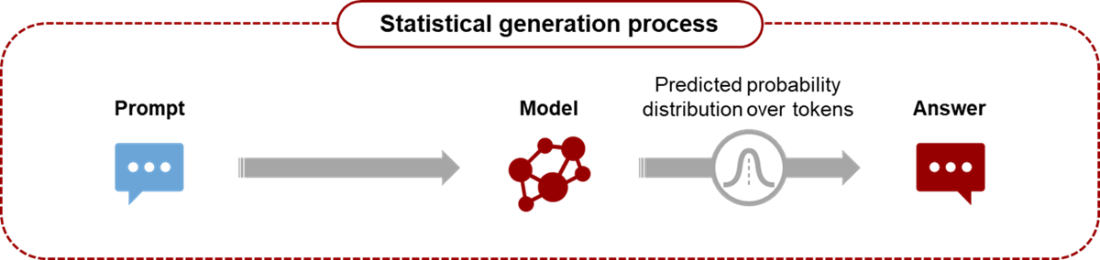
The figure contrasts step-by-step token selection with explicit rule execution. section 6.3.1
Scale combines model capacity, broad training data, and computation. Exposure to varied contexts helps a model learn both recurring patterns and context-dependent associations; increasing parameters alone is not the whole story. Scaling also changes the costs of building and deploying systems, affecting who can develop them. section 4.2.2 section 4.0
Patterns of language use can organize related words into mathematical representations, capturing relationships richer than grammar alone. Whether those relationships amount to understanding remains contested. A text-only model learns from descriptions of the world rather than direct experience; multimodal training can add image, audio, or video evidence, but does not guarantee understanding. section 1.5.6 section 1.5.7 section 4.5.1
A convincing medical explanation
A model may clearly explain a medical treatment and answer follow-up questions. That fluent explanation does not establish that it has verified its claims or judged whether they apply to a particular patient. section 1.1.3
Plausible continuation is not the same objective as factual correctness. A model can produce a confident hallucination when its available patterns or evidence are weak. It can also reproduce social biases found in its training data, and relevant details may be missing or weakly represented in its current context. Reliable external information and verification steps can reduce some errors, but do not eliminate them. section 6.1.2 section 6.4 section 7.3.2 section 6.5
























































































