Machine learning (ML) uses examples to learn patterns or predictive functions from data, rather than relying solely on explicitly programmed rules. In drug discovery, it can help prioritize molecules for testing across a chemical search space too large to explore exhaustively. ML is a subfield of artificial intelligence; deep learning is a subfield of ML that uses deep neural networks. section 1.1.1 section 1.5
A molecule must first be represented in a form a model can use, such as a SMILES string or a molecular graph. In supervised learning, measured properties provide labels: for example, an assay may report whether a compound binds a target or harms cells. The quality and consistency of those measurements limit what the model can learn. section 1.5 section 1.1.1
During training, a model learns a mapping from features—characteristics of each example—to labels. In a parametric model, a learning algorithm adjusts weights using a loss function for individual errors and a cost function that aggregates them. After training, the weights are frozen and the model makes predictions on new inputs during inference. section 3.0 section 3.3.1
Predicting cardiotoxicity
A ligand-based screening project can use molecular features to predict whether compounds block hERG, a property relevant to cardiotoxicity. Gather and standardize molecule data, train a linear classification model, then evaluate its predictions with confusion-matrix metrics. The aim is not just to fit known compounds, but to generalize to compounds the model has not seen. section 3.0 section 3.3.1 section 3.5
Figure 3.9 Parametric ML model during training. Our ML model learns a function that maps each input data instance to a prediction about a property of interest. The loss and optimization functions measure and aggregate the performance of the model’s predictions. In tandem with a learning routine, the model’s weights are updated such that, in the next iteration of training, the model will reduce its previous error and perform better.
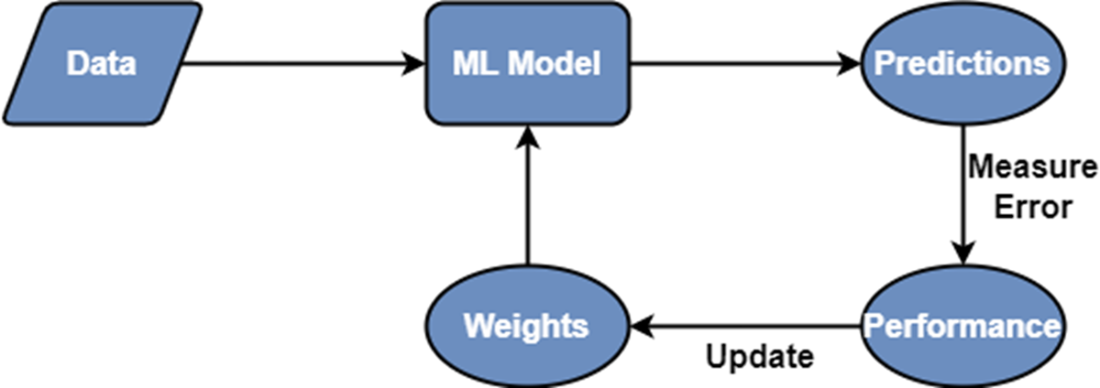
Follow how a parametric model turns inputs into predictions and updates its weights using error during training. section 3.3.1
A practical ML workflow includes:
- Define the problem and success criteria, and decide whether ML is appropriate. section 3.0
- Acquire, explore, clean and standardize data; convert relevant characteristics into model features. section 3.0 section 3.5
- Train and compare models, analyze errors, and use cross-validation and regularization to address generalization and overfitting. section 3.0 section 3.5
- Save the selected model for use on new data; in production, monitor performance and reassess whether it meets its objective. section 3.5 section 3.0
ML is not always the best screening method. Simple compound filters and similarity searches provide alternatives and comparison points. In a hierarchical screening pipeline, inexpensive filters can reduce a large library before more costly methods such as docking. For ligand-based classification, examples of both positive and negative compounds make ML available; with only positive examples, search-based strategies may be more appropriate. section 2.1.1