Machine learning (ML) builds programs that learn decisions from data rather than relying on explicitly coded decision patterns. In fraud detection, it learns relationships between historical inputs and fraud outcomes so systems can handle growing volume and changing attack patterns. section 1.3 section 3.0
Phishing classification
A phishing detector can use email attributes such as sender ID, body length, and attachment count as features, then learn to predict a binary output: fraud or not fraud. The trained model applies that learned relationship to a new email. section 1.3
A practical fraud ML workflow moves from labeled data to a deployed decision system:
- Extract or engineer useful features from structured input data, then train a model on features paired with known outcomes. section 1.3
- Use classical ML when meaningful features can be explicitly defined; it can learn useful feature combinations instead of requiring humans to encode every rule. section 1.4 section 3.1
- Use deep learning for unstructured inputs such as text, images, audio, video, or graphs when manual feature extraction is difficult. section 1.4
- Keep rules for exceptional cases, regulatory obligations, or situations requiring especially simple and fast decisions. section 1.7 section 3.1
ML can model nuanced fraud patterns, improve with additional training data, and be retrained or fine-tuned more readily than a large mesh of rules. The trade-off is that model decisions are less straightforward to debug or interpret, and latency is typically higher than a simple rule. section 3.1
Figure 3.3 Steps in building and deploying an online transactions fraud detection system, starting with the dataset, training models, engineering features, and deploying the model as an application.
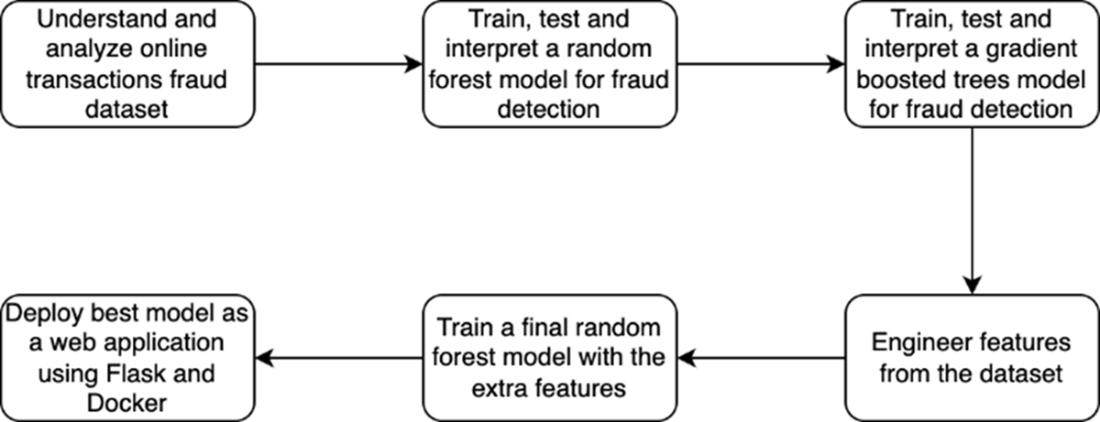
Follow the end-to-end path from transaction data through feature engineering and model training to a deployed fraud-detection application. section 3.1