A spam filter could look for suspicious words, but senders can evade a fixed rule by changing “sell” to “s3ll.” Machine learning offers another approach: use examples of legitimate and spam messages to learn patterns that help distinguish them, rather than writing every rule by hand. section 2.4
Machine learning uses sample data and interactions to develop models that make predictions or recommendations. In a recommender system, past interactions help the model estimate which items a user may value. If someone engages more with one followed account than another, the system might recommend more from the first account. section 1.1.2 section 4.2
Interactions reveal only some preferences. A feed can keep showing familiar content while missing interests that have not yet surfaced. Recommenders therefore face an exploration-versus-exploitation trade-off: show items already likely to appeal, or try different items to learn more. Too much of either can make the feed less valuable. section 4.2
Figure 4.1 Recommender systems learn our preferences by observing our interactions with the items they present. There is no guarantee that all the preferences will be appropriately accounted for. In this figure, the user is a book lover, but the system is unaware of their preferences, and it’s reinforcing the known ones.
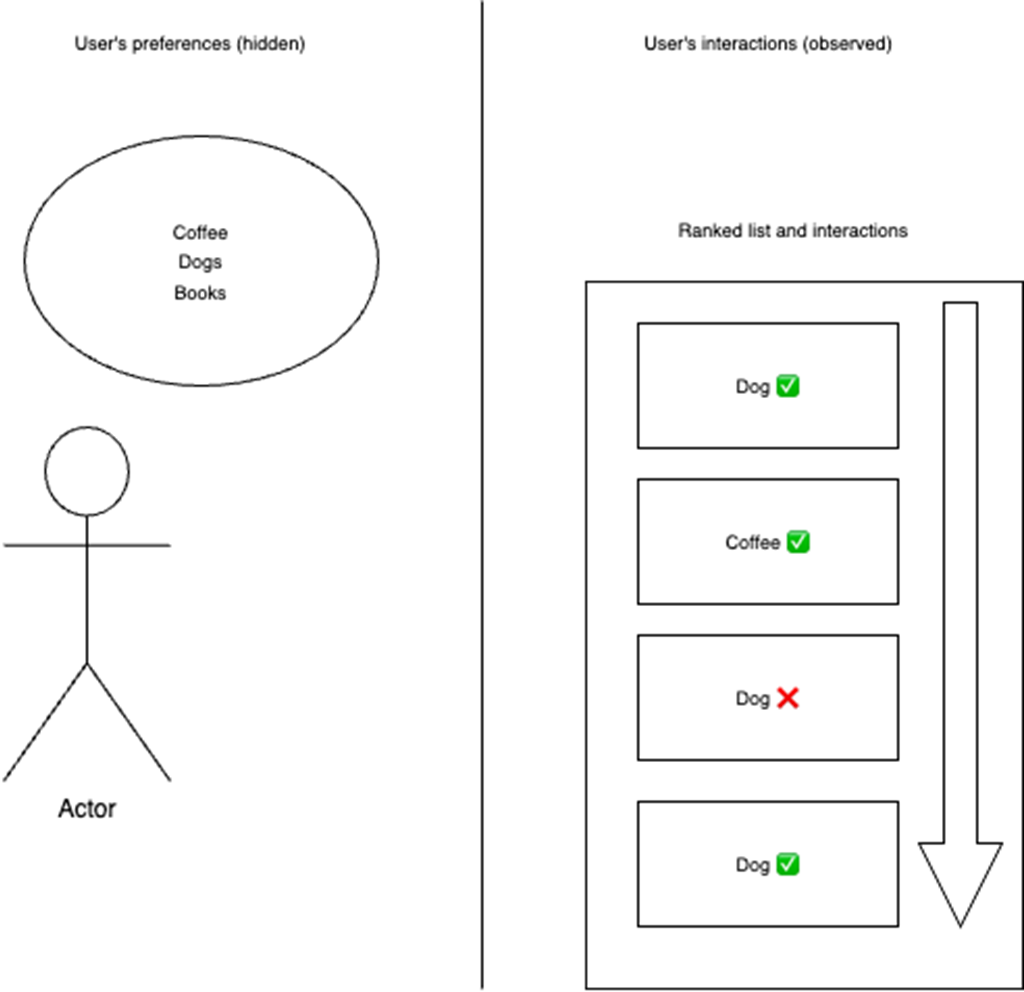
The figure illustrates how a recommender can reinforce known interests while overlooking another preference. section 4.2
Deep learning can build more abstract representations from data in successive layers. For example, information about login times may contribute to a representation of when a user is active. Models can also produce embeddings: internal representations of users and items used in recommendation tasks. These representations can be difficult to interpret in human-readable terms, making individual recommendations hard to explain. section 2.7 section 1.1.2
Finding policy-related content
A model trained on previously labeled posts could help identify content relevant to a policy. But determining whether a post supports or opposes the policy remains difficult: a nuanced analysis may discuss both benefits and drawbacks, and sarcasm or missing context can challenge even human readers. section 4.7.1
Learning from data can make recommendations engaging, but it does not guarantee that a system understands a person’s full interests or that its effects are easy to assess. A search that changes a feed may be useful, or it may lead toward harmful content; measuring those effects matters. section 1.1.2 section 4.2